

The
Challenges In Space
Every surface is under attack.
In space, small problems become catastrophic.
Our Services
We fight for clean oceans and air—but space is a junkyard, and its debris is slowly threatening life on Earth.

Over 1.3 million pieces of debris orbit Earth today—and more than 130 million remain untracked, threatening every mission.
COLLISION CASCADE


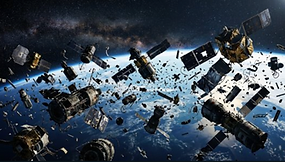
In just 3.8 days, there is a 50/50 probability of a catastrophic collision in orbit.
A single satellite can break into thousands of fragments.
Each fragment can collide with others, triggering a chain reaction known as Kessler Syndrome, where one collision leads to many more.
Two events (2007 & 2009) created 33% of all tracked space debris.
RE-ENTRY POLLUTION

The only current solution is to let broken satellites burn up on re-entry.


But when they do, they release toxic metals like lithium—polluting the atmosphere, damaging the ozone layer, and threatening human health.
We aren’t cleaning up space—we are using our atmosphere as a trash incinerator.
The environment itself is just as dangerous as the debris.
Threats

Dust In Space
Dust In Space
On the Moon, Mars, and even in orbit, dust sticks to surfaces, over time, this buildup can block sunlight, reduce energy efficiency, and limit a spacecraft’s ability to operate at full capacity. What starts small can grow into big problems, threatening the success of an entire mission.

Micrometeoroids and space debris travel at incredible speeds. Even minuscule impacts to spacecraft can create cracks, weaken materials, or destroy coatings. These damages are often invisible at first, they accumulate over time, slowly weakening the spacecraft. What starts as a tiny scratch can eventually threaten critical systems.
Impacts

Extreme temperatures and radiation
Spacecraft surfaces face enormous temperature swings—from freezing cold to extreme heat—sometimes within the same orbit. Materials expand, contract, and wear down with every cycle. High-energy radiation further breaks down coatings, polymers, and solar cells, reducing efficiency and shortening mission life.
Why Existing Systems Aren't Enough
Most spacecraft surfaces today are passive, designed to withstand damage rather than respond to it. Protection, sensing, and power are handled by separate, disconnected systems, adding extra mass and complexity to the spacecraft. Because these systems don’t work together, spacecraft can’t react in real time, allowing small surface issues to grow into mission-threatening failures.
For example, Whipple shields, which are used to vaporize debris, add significant weight, increase volume by up to 30%, and can cost around 10% of an entire mission. Once damaged, they cannot recover—leaving sections permanently compromised.


Why This Matters
In space, repairs aren’t an option. Once satellites fail, they cannot be repaired. Small cracks become mission-ending failures. In fact, between 2009 and 2016, 42.6% of small-satellite missions failed. Every launch represents years of work, billions of dollars, and irreplaceable scientific opportunity. As missions become longer, farther, and more ambitious, surviving is no longer enough. Spacecraft need surfaces that can sense change, respond instantly, and adapt as conditions change.